Fibered Laser Shock Peening
Overview
Laser Shock Peening is a surface treatment process used to improve the mechanical resistance of components by inducing compressive residual stresses. These stresses improve resistance to stress corrosion, corrosion fatigue and crack propagation.
LSP originates from conventional peening processes such as shot peening, where metal, ceramic or glass shots are projected onto metallic parts to create plastic deformation and compressive residual stress. While effective, shot peening can generate foreign object damage and remains less precise and less deterministic than laser-based treatment.
LSP replaces mechanical impacts with laser beams which could generate more directive and precise shock waves on the treated materials.
Process highlights
LSP offers measurable benefits compared with conventional peening methods:
- High level and depth of compressive residual stresses
- Reduced impact on surface finish and roughness
- Fatigue life increase, typically by a factor of five or more
Experimental results obtained on metallic materials also showed residual compression levels exceeding 400 MPa and affected depths greater than 1 mm.
Industrial constraints
Despite its performance, LSP remains difficult to deploy in industrial environments. Most conventional implementations rely on free-space beam delivery and typically involve:
- High-power Class IV lasers
- Dedicated secured installations or cabins
- Positioning or disassembly of parts before treatment
- Limited suitability for maintenance and in-situ operations
These constraints reduce process flexibility in real production and maintenance conditions.
What we offer
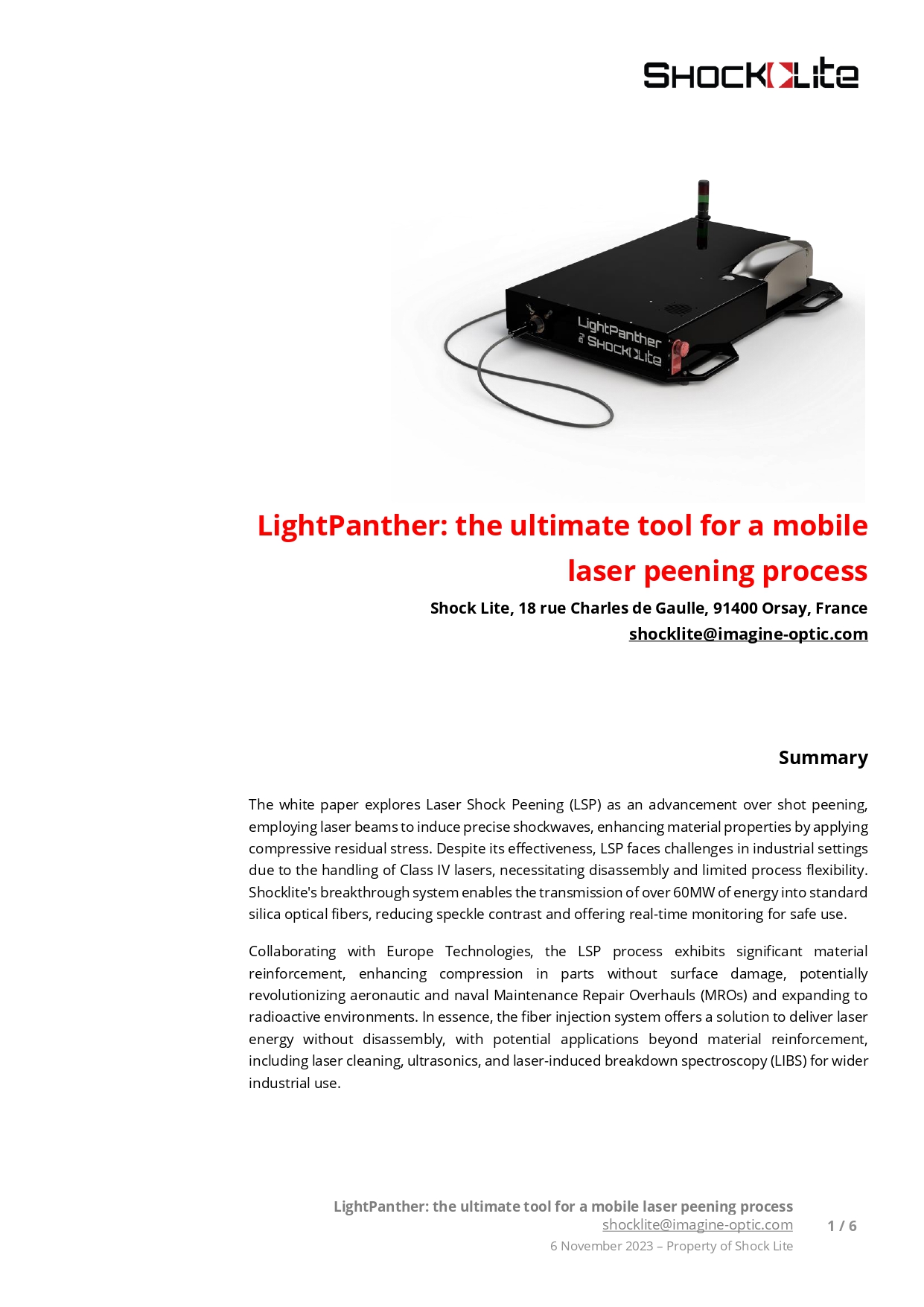
Shocklite addresses these limitations with a fiber-based approach to laser peening using the LightPanther system. This makes it possible to transmit energetic nanosecond laser pulses through optical fiber and bring laser energy directly to the treatment area.
For LSP users, this approach brings several practical advantages:
- Increased accessibility in confined, hard-to-access or harsh environments
- No need to dismantle parts before treatment
- Laser equipment can remain away from local disturbance sources while energy is delivered to the part
The LightPanther supports high output energy levels through optical fiber, reaching up to 350 mJ at 1064 nm under specified conditions.
At the fiber output, a compact optical module can be used to obtain a sub-millimetric spot size at a working distance of 50 mm, enabling peak power densities up to 7 GW/cm² for LSP applications.
Shocklite can also support customers with beam control along the transmission line, including customized focusing heads, and with preliminary tests on representative parts using its internal laser peening platform.
Application context
Fiber-delivered LSP is particularly relevant for:
- Aeronautics and naval maintenance operations
- Components with limited accessibility
- Industrial environments requiring local and flexible surface treatment
White Papers