
LightPanther
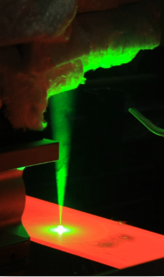
High-energy nanosecond pulses, delivered at the tip of a silica fiber.
LightPanther separates the laser source from the point of treatment. Nanosecond pulses travel up to 60 m of standard silica fiber and arrive with their energy and duration intact — so the beam goes to the part, instead of the part going to the beam.
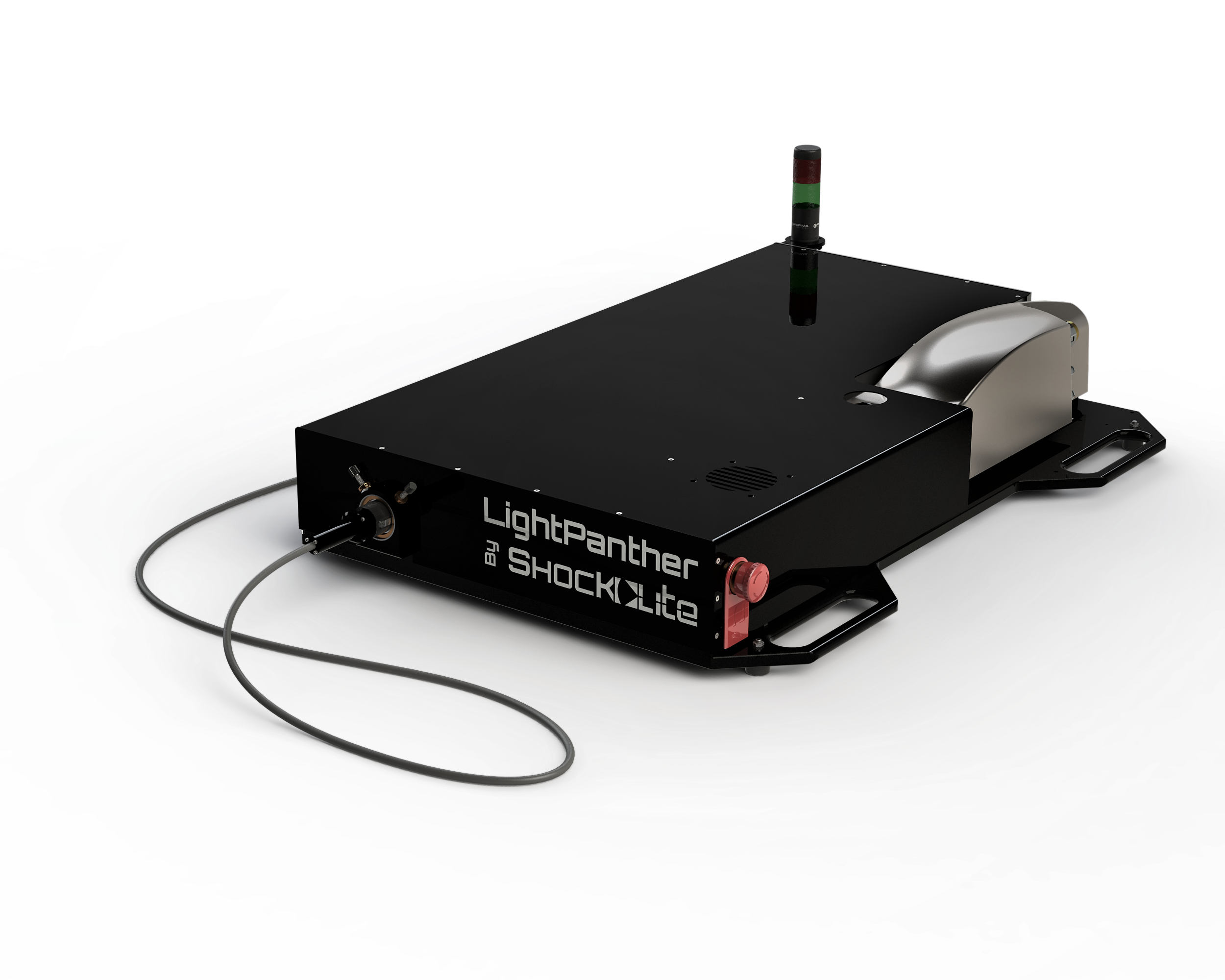
- 60MW Peak power demonstrated in the nanosecond regime
- 6ns Typical pulse duration at the fiber output
- 60m Maximum fiber length between source and part
- 100sof mJ Energy transmitted per pulse
Why fiber delivery
High-energy laser processes are proven in the lab. What keeps them out of the workshop is usually not the physics — it is how the beam gets to the part.
With free-space delivery
Class IV installations, dedicated enclosures, and a fixed optical path. Parts have to be brought to the beam, positioned, and often disassembled before treatment.
In-situ work, maintenance operations and confined environments are effectively out of reach.
With LightPanter
A dedicated beam-shaping architecture reduces the spatial coherence of the beam and limits intensity peaks at the fiber input, which is what makes high-energy coupling into a standard fiber possible.
The source stays where it is. The fiber goes where the work is — on a bench, in a hand, or on the end of a robot arm.
Capabilities
Figures for the standard configuration. Custom output profiles and fiber lengths are available on request.
| Energy per pulse | Up to hundreds of mJ |
|---|---|
| Pulse duration | ≈ 6 ns |
| Peak power demonstrated | > 60 MW |
| Fiber length | Up to 60 m |
| Fiber type | Standard single-core silica |
| Output intensity profile | Stable top-hat |
| Beam shaping at output | Circular, square or linear |
| Configurations | Fixed, handheld or robot-mounted |
Because the profile at the fiber output is a stable top-hat, the process sees the same spot from one shot to the next, wherever the fiber is pointed.
Monitoring and control
① The system ships with software that watches the fiber while it runs.
② Real-time monitoring of the fiber input facet
③ Automatic interruption of lasing if fiber damage is detected
④ Energy control with single-shot, continuous and burst modes
⑤ Assisted fiber alignment and replacement by the operator
Where it is used
Processes that need high-energy nanosecond pulses delivered somewhere a fixed optical path cannot reach.
Laser shock peening
Compressive residual stress on parts treated in place.
Laser cleaning
Selective surface removal without abrasives or solvents.
Laser ultrasonics
Contactless generation of ultrasound for inspection.
LIBS and spectroscopy
Remote elemental analysis in constrained environments.
Sectors: Aeronautics — Energy — Naval — Metallurgy — Geology — Medical
White Papers
Laser Shock Peening
Laser Ultrasonics
DATASHEET
GALLERY
VIDEOS